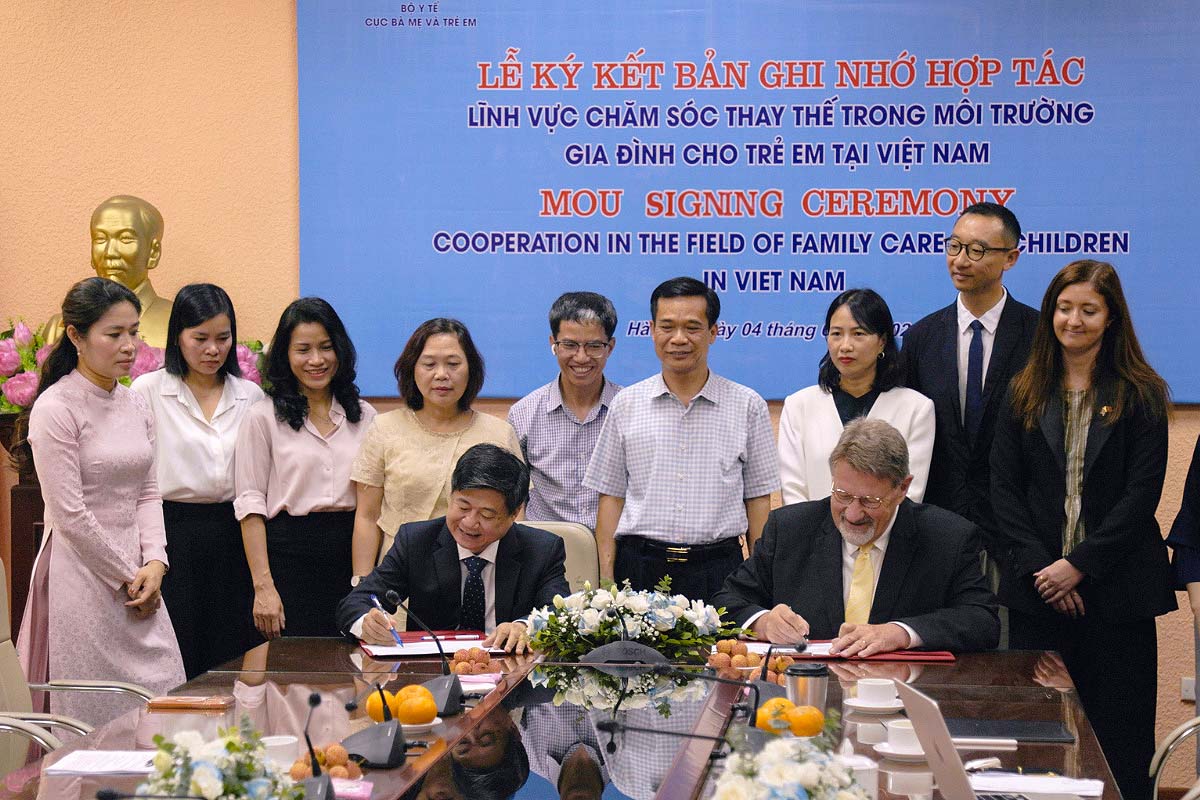
Care for Children is delighted to announce the signing of a new MOU with the government in Viet Nam, commencing an exciting new chapter in our work to support children through family-based care.
An MOU is a formal agreement between parties that outlines shared goals and intentions to work together. For Care for Children, this is an important milestone in our strong long-term relationship with partners in Viet Nam.

Recognising the role of long-term foster care
Crucially, as part of the signed MOU, the Ministry of Health has formally recognised long-term foster care as an important part of permanent care planning for children. This represents major progress in ensuring more children can grow up in safe, stable and loving family environments.
Through the agreement, the Ministry has committed to strengthening the implementation of long-term foster care within Viet Nam’s child protection system, affirming that family-based care is in the best interests of the child.
Viet Nam now joins countries including the United Kingdom, Norway, Sweden, Australia, New Zealand, US, Canada, China and many others now formally recognising long-term foster care as an important permanency option alongside reunification, kinship care, guardianship and adoption.
A new project site
The partnership will launch a new project in the city of Hue, located in central Viet Nam. Once the imperial capital of the country, Hue is home to a population of more than 1.5 million people and has been identified as a strong location for this important new initiative.
As part of the new project, Care for Children will work closely with the Social Work Center and Child Protection Fund in Hue to promote and prioritise family-based care for vulnerable children. This will include training and supporting staff, as well as helping to recruit and develop local families who can provide safe, loving family environments for children in need.
We are incredibly excited about this partnership and the opportunities it presents. Together with our partners in Viet Nam, we look forward to seeing children experience the stability, belonging and opportunity that family-based care can provide.